Good Wine, But How?
Wine is not just a beverage; it is an art where nature, labor, and time meet in perfect harmony.
Wine is not just a drink; it is an art where nature, labor, and time meet in perfect harmony. At the heart of this art lies viticulture. Every single grape berry acquires a different aromatic character under the influence of dozens of factors, ranging from the mineral structure of the soil to the climate, and from cultivation techniques to the harvest time. In this article, we will examine this fascinating journey step-by-step, from the intricacies of viticulture to the aromatic development of wine. The title also contains a beautiful question. There are so many factors that fill in the answer to this question. But first, we must say this: Wine is made from wine grapes. This is because table (eating) grapes are harvested before they reach a very high sugar concentration. In fact, when eating grapes, we do not want them to overwhelm us with excessive sweetness. In wine grapes, however, it is the opposite: sugar accumulation is a good thing for wine. Furthermore, in table grapes, we cannot find the balance factors we seek in wine. The balance components in wine are acid, sugar, alcohol, tannin, and fruit aromas. This subject will be handled separately under another heading. Another point is that we can categorize wine grapes among themselves as those that can age or those that should be consumed young without aging, and those with high or low aromatic intensity. When speaking of "good wine," this detail should not be overlooked.
What Are the Growing Conditions for Grapes?
For productive vineyard cultivation, climate, soil, and geographical structure are the three most critical factors. Thanks to its location in the Mediterranean climate belt, Turkey is an extremely advantageous country for viticulture.
Ideal growing conditions are as follows:
Climate: Grapes need warm, sunny days and cool nights. This temperature difference is important for sugar accumulation and acid balance.
Soil: Calcareous, well-drained, and slightly sloping soils increase grape quality.
Water management: Excessive irrigation weakens the aroma of the grapes. Controlled irrigation is essential, especially for producers engaged in wine grape cultivation.
Wind and sun orientation: Establishing vineyards on south-facing slopes optimizes the photosynthesis process. Managing these conditions correctly is the first step toward obtaining quality grapes and producing aromatic wine.
Main factors affecting aromatic intensity:
- Harvest time (early harvest = high acidity, late harvest = high sugar),
- Vineyard age (old vines produce more complex aromas),
- Microclimate conditions (the climate of the specific location where the vineyard is situated),
- Soil mineral structure.
At the top of the factors affecting the quality of wine is terroir (pronounced: teruar; from here on in this article, it will be written as it is pronounced in Turkish). Its origin is the Latin word terra (soil). In Medieval French, it began to be used in the sense of “the soil and characteristics of a specific place.” Its first use in the context of wine vineyards was carried out by monks in Burgundy between the 12th and 13th centuries during the Middle Ages. The monks observed and recorded the soil structure, slope, sun exposure, and microclimate of the vineyards. These monks are considered the first community to consciously and systematically apply the idea we call “terroir” today.
In the 18th century, the word terroir began to appear clearly in French agricultural and wine literature. In the 19th century, the concept became a central theory explaining the quality and character of wine, and finally, towards the middle of the 20th century (the 1930s), terroir became an official legal and technical concept in France with the AOC (Appellation d’Origine Contrôlée) system. In short, terroir refers to the piece of land that imparts characteristic features to the product grown; it expresses the effect of a region's climate, soil structure, landforms, and the winemaking methods used in that region on the flavor of the wine. While we are still at the beginning of our topic, it is useful to state this: grapes grow between the 30th and 50th parallels in both the Northern and Southern Hemispheres. Below 30 is too hot, and above 50 is too cold. Therefore, grapes do not grow in regions outside these parallels.
Let's continue our topic with terroir. The location of the vineyard is very important for a quality wine. Factors such as the direction of the vineyard (it must face south to receive sunlight), slope (in sloping vineyards, every row receives equal sun), being by a river (important for grapes with a late and long ripening period, e.g., Riesling. The river increases the vineyard's resistance to frost events while contributing to the warming of the vineyard by reflecting sunlight), being in a region with a sea (breezes from the sea cool the vines), the stoniness of the soil in connection with the vineyard's location (for example, in temperate and cool climates, the stoniness of the soil structure is important for the warming of the vineyard), and the altitude of the vineyard (the day-night temperature difference is very important for the grape; grapes undergoing this type of ripening phase carry aging potential as they preserve their acidic structure) contribute to the healthy growing conditions of the grapes. There are also other climatic factors affecting terroir. For example, the cloudy structure of a region (e.g., Hunter Valley, Australia) or exposure to fog, which has a cooling effect, are among these factors. We must also mention that the human factor affects terroir. This will be discussed under a separate heading. Up to this point, we have generally tried to explain the concept of terroir and understand its importance.
For a Good and Quality Wine:
- Knowing and understanding the characteristics of the terroir and carrying out viticulture activities accordingly,
- Turning to the grape variety suitable for the soil,
- Executing vineyard management correctly,
- Executing winery management correctly,
are the points we can list. Above, we tried to understand what terroir is and its importance. Now, let’s briefly touch upon the subject of the grape suitable for the soil, which is one of the elements of a quality wine.
Turning to the Grape Variety Suitable for the Soil:
Specifically, the wine grape–soil relationship directly affects the acid structure, tannin quality, aromatic intensity, and ripening speed of the grape.
Main Soil Types:
- Calcareous (limestone) → Preserves acidity, elegance,
- Clay → Power, body, tannin,
- Sandy → Lightness, early ripening,
- Gravelly / Stony → Drainage, concentration,
- Schist / Slate → Minerality, depth of aroma,
- Volcanic → Vitality, salinity, minerality, spice.
Some Grape Varieties, Suitable Soils, and Characteristic Structure
Cabernet Sauvignon:
- Soil: Gravelly, stony, clay-gravel,
- Reason: Ripens late, wants good drainage and warm soil,
- Example: Bordeaux-Médoc.
- Terroir and Character Relationship: Although Cabernet Sauvignon is a genetically very dominant grape, it reflects the characteristics of the terroir (soil, climate, slope) in which it grows like a mirror. We can examine the relationship between terroir and character for this grape under three main headings: 1. Soil and Textural Character (Tannin Structure) “Tannin,” the most prominent feature of Cabernet Sauvignon, changes shape according to the soil structure. Gravelly Soils (e.g., Bordeaux): These soils do not hold water and force the vine to send its roots deep. The result is firm tannins that give the wine a “backbone,” which are strong, angular, and turn into a silky texture as they age. Clay/Loamy Soils: Since the water-holding capacity is higher, the grape experiences less stress. This situation creates a character where tannins are softer and the fruit is more prominent, making it “suitable for early drinking.” Volcanic Soils (e.g., Napa Valley): These soils add a “dusty” texture and a distinct mineral depth to the grape. 2. Climate and Aromatic Profile Cabernet Sauvignon naturally possesses compounds called methoxypyrazines, which smell like “green pepper/herbaceous.” The warmth of the terroir determines the evolution of these aromas: Cool Terroirs: If sun and heat are insufficient, these green notes remain dominant. Aromas of freshly cut grass, bell pepper, or eucalyptus are felt in the wine. Warm Terroirs: In regions where the sun is intense, this “green” character gives way to black fruits (blackberry, blackcurrant) and a more “jammy” structure. Day-Night Temperature Difference: In terroirs where this difference is high, the grape preserves its high acidity. This allows the wine to remain “fresh” and “vibrant” despite its high alcohol content. 3. Drainage and Concentration Cabernet Sauvignon does not like its roots to be wet. The drainage capability of the terroir (the speed at which water filters through) determines the concentration of aromatic substances within the grape. If the terroir has good drainage, the berries remain small. Small berry = more skin and therefore less water. This directly means a darker color, more intense aroma, and higher aging potential (due to the abundance of tannins with antiseptic properties).
Merlot:
- Soil: Clay, clay-limestone,
- Effect: Clay retains moisture, increasing Merlot’s softness,
- Example: Bordeaux-Pomerol.
- Terroir and Character Relationship: While Cabernet Sauvignon likes "warm and dry" feet, Merlot prefers cooler and damper soils. The soil in which Merlot grows directly determines the texture of the wine on the palate: Merlot in Clay Soil: Exhibits a fuller-bodied character with high tannins, where black fruit (plum, blackberry) and earthy notes are dominant. Merlot in Sandy Soil: Produces a much softer, silky wine with low tannins, focused on red fruit (strawberry, raspberry), and suitable for early drinking.
Pinot Noir:
- Soil: Calcareous, clay-limestone,
- Effect: Elegance and acidity are preserved in low-yield soil,
- Example: Bourgogne.
- Terroir and Character Relationship: Pinot Noir is known as the “spoiled child” of the grape world because it is incredibly sensitive to changes in terroir. Even the slightest difference in soil can completely change the aroma and texture of the wine. The soil structure where this elegant and thin-skinned grape finds its true identity is a mixture of limestone (calcareous) and clay. Clay gives Pinot Noir the light body and depth of color it needs, while limestone adds acidity and minerality. This structure, seen in Burgundy’s most valuable vineyards (Grand Cru), is a perfect balance of clay and limestone.
Syrah / Shiraz:
- Soil: Granite, schist, stony-clay,
- Effect: Loves heat, mineral structure deepens the aroma,
- Example: Northern Rhône.
- Terroir and Character Relationship: Although Syrah (or Shiraz as it’s known in Australia) is a durable and adaptable grape, it generally gives its most characteristic and “wild” aromas in poor and mineral-rich soils. Syrah’s soil choice directly determines whether the wine will be in the “Old World” (France) or “New World” (Australia) style. Here are the soil structures Syrah loves most:
- Granite and Crystalline Soils
The first region that comes to mind when Syrah is mentioned is the Northern Rhône (especially Hermitage and Côte-Rôtie), which consists of steep-sloped granite hills. Aromatic Depth: Granite soils impart those famous black pepper, smoked meat, and violet notes to Syrah. Heat Management: Granite stones hold heat well and keep the vine warm throughout the night, ensuring the grapes reach full maturity.
- Schist and Micaschist (Slate)
Syrah loves schistose soils consisting of fragmented rocks. Drainage and Stress: These soils allow water to flow away quickly. The vine is forced to send its roots very deep (sometimes 10-15 meters) to find water. This deep root structure adds high minerality and a strong tannin structure to the wine.
- Limestone and Clay
Syrah gives more elegant results with higher acidity in limestone soils. Softness: As the clay ratio increases, Syrah becomes fuller, more fruity (black olive, damson plum), and softer in texture. The iron-oxide red clay soils of Australia’s Barossa Valley are the main source of Shiraz’s very full-bodied and intense character.
Chardonnay:
- Soil: Calcareous, chalky,
- Effect: Acidity and minerality come to the fore,
- Example: Chablis.
- Terroir and Character Relationship: Although Chardonnay is the white grape spread over the widest geography in the world, it yields its highest quality examples in specific geological structures. The character of this grape varies across a wide spectrum, from a “sharp and acidic” structure to a “full and exotic” structure depending on the lime and mineral content of the soil. Here are the soil structures Chardonnay loves most: 1. Limestone and Calcareous Chardonnay’s soulmate is limestone. The world's most prestigious Chardonnay regions (Burgundy - cool climate) are built on this white, chalky soil structure. Vibrant Acidity: Limestone soils preserve the acid level of the grape, which provides freshness and a long finish to the wine. Minerality: Characteristic mineral notes described as “flint” or “wet stone” are dominant in Chardonnays grown in these soils and in cool climates. 2. Clayey-Limestone Especially specific to the Chablis region, this soil consists of sea shell fossils remaining from millions of years ago and clayey limestone. This soil type adds a slightly salty (saline) and iodine sea character to Chardonnay that is found nowhere else. 3. Loamy and Clay Soils In warmer climates (California, Australia, or some interior regions of Turkey), the character of Chardonnay changes completely when grown in clay or loamy soils. Body and Aroma: Clay retains water, allowing the grape to be fuller and more “fleshy.” Wines made from grapes grown in these soils exhibit more tropical fruit (pineapple, mango) and buttery notes.
- Terroir and Style Relationship Chardonnay is a grape that combines the effect of terroir with the use of barrels: Limestone/Cool Climate: Usually aged in steel tanks; a style with high acidity, vibrancy, and green apple/lemon aromas is formed. Clay-Loam/Warm Climate: Usually goes into oak barrels; a full-bodied style emerges, with low acidity, becoming enriched with creamy, vanilla, and hazelnut notes.
Sauvignon Blanc:
- Soil: Calcareous, gravelly,
- Effect: Aromatic vitality and freshness,
- Example: Sancerre.
- Terroir and Character Relationship: Sauvignon Blanc is very sensitive to the mineral structure and water-holding capacity of the soil in order to reflect those unique sharp, “freshly cut grass” and “tropical fruit” aromas. The character of this grape changes dramatically according to the geological history of the soil it grows in. We can list the soil structures where Sauvignon Blanc is most successful as follows: 1. Limestone and Kimmeridgian Marl The world's most famous Sauvignon Blanc region, Sancerre (France), consists of limestone and fossilized soils. These soils add incredible acidity, elegance, and minerality to the wine. That smoky and sharp mineral note described as “flint” is the signature of this soil. What is Kimmeridgian Marl? Geologically dating back to the Upper Jurassic period about 150-155 million years ago, it is one of the world's most precious wine soil structures. The secret of the famous mineral character of France's Chablis and Champagne (Sancerre and Pouilly-Fumé) regions is this soil. Here are the fundamental features that make this special structure unique: a. Content: A Heritage from the Sea This soil does not consist merely of mud or clay; it has a dense fossil content resulting from the region being a shallow sea in ancient times. The real signature of Kimmeridgian soil is the small, comma-shaped ancient sea shell (oyster) fossils found within it. Kimmeridgian soil is also a homogeneous mixture of limestone rich in calcium and clay with water-holding capacity. b. Character It Adds to the Wine Kimmeridgian Marl imparts the following features to the grapes grown upon it (especially Chardonnay and Sauvignon Blanc): Iodine and Salty Notes: It causes a “sea breeze” or a slightly salty finish to be felt in the wine. Flint Aroma: Especially in regions like Sancerre, it gives the wine a smoky and metallic minerality. High Acidity and Elegance: Thanks to the lime content, the acidity of the grapes remains very high and vibrant. This soil type is not found everywhere. It passes underground like a “vein,” and the points where this vein comes to the surface are registered as the world's most prestigious vineyards (Grand Cru and Premier Cru). While the clay in the soil preserves the moisture the vine needs, the limestone structure filters the excess water, preventing the roots from rotting. This soil is a “poor” soil. To survive, the vine must send its roots deep into these fossilized layers, which concentrates the aroma of the fruit. In summary, if you get “oyster shell” or “sea minerality” in a Chablis wine, it is because the roots of the grape are touching this 150-million-year-old fossilized marl layer. 2. Gravelly and Stony Soils This structure, seen in some parts of Bordeaux, brings drainage to the highest level. Because gravelly soils reflect heat well, they ensure more balanced ripening of the grape. Here, Sauvignon Blanc generally exhibits a fuller-bodied structure, suitable for slight oak themes and more complexity. 3. Sandy Soils Sandy and well-drained soils are prominent, especially in regions like New Zealand (Marlborough). Sandy soils encourage aromas to develop faster and more intensely. Sauvignon Blancs grown in these soils present those famous gooseberry, grapefruit, and passion fruit notes in a much more striking way. Terroir and Style Relationship The character of Sauvignon Blanc revolves around two main axes depending on the soil type: Mineral-Oriented (Limestone/Silex): More delicate, high acidity, with lemon and wet stone aromas. Fruit-Oriented (Sandy/Loamy): More aromatic, smelling of tropical fruit and fresh herbs. Because the aromatic structure of this grape is very volatile, it is generally produced in steel tanks without using oak barrels.
Riesling:
- Soil: Schist, slate (Arduvaz stone),
- Effect: Minerality and high acidity,
- Example: Mosel.
- Terroir and Character Relationship: 1. Slate (Arduvaz stone) This is the first soil type that comes to mind when Riesling is mentioned, especially in the Mosel region of Germany. Heat Retention: Slate stones, especially on steep slopes, trap solar heat throughout the day and return it to the vine at night. In cool climates, this is vital for Riesling to ripen. Aromatic Character: Blue slate adds more floral notes to the wine, while red slate imparts a spicier and fuller structure. Minerality: Since the vines go very deep to reach water in these soils, the famous “petrol” (becoming more distinct as it ages) and flint notes are very strong in Rieslings. 2. Granite and Volcanic Soils Riesling creates wonders in these soils, especially in the Alsace region of France. The granite soils of the Alsace region give Riesling a more upright, hard, and masculine structure. Volcanic soils, on the other hand, make fruit aromas (peach, apricot) more concentrated and add a smoky mineral depth to the wine. 3. Limestone Riesling grown in limestone soils is the style that displays its acidity in the most “brilliant” way. Limestone gives the grape high acidity along with a delicate structure and a citrus-focused (lime, grapefruit) profile. 4. Sandy and Loamy Soils These soils are generally found in flatter areas and produce Rieslings “suitable for young drinking.” Rieslings grown in sandy soils are softer, less mineral-oriented, and prominent with their fruity character.
Öküzgözü:
- Soil: Calcareous (Limestone), alluvial,
- Effect: High acidity, fruity character,
- Example: Elazığ.
- Terroir and Character Relationship: 1. Clayey-Limestone and Alluvial Soils Öküzgözü particularly loves the clayey-limestone soils in its homeland, Elazığ and its surroundings. Water Balance: Clay provides the moisture needed by this large-berried grape by retaining water. Acidity: Limestone helps the grape preserve its famous high acidity and freshness. Alluvial Structure: Alluvial deposits brought by the Euphrates River enrich the soil in terms of minerals and add characteristic depth to the grape. 2. Sandy-Clayey Structures Sandy soils allow the roots to spread easily and provide good drainage for water. When Öküzgözü is grown in this type of soil, its aromatic profile becomes more distinct, exhibiting more delicate, floral (like violet) notes. Where Öküzgözü is grown determines the weight of the wine on the palate: High Altitude and Lime: Öküzgözü grown in the high-altitude plateaus of Elazığ and in limestone soils is more vibrant, high in acid, and focused on red fruit (raspberry, cherry). Warmer and Clayey Areas: The grape acquires a fuller, darker-colored, and slightly spicy character.
Boğazkere:
- Soil: Limestone, stony,
- Effect: Strong tannin, long life,
- Example: Diyarbakır.
- Terroir and Character Relationship: These hard and limestone soils contribute directly to the thickening of the grape's skin and therefore to the formation of that famous tannin structure. If grown in very soft or excessively wet soil, the grape may lose its unique full-bodied and strong structure and exhibit a more ordinary profile.
Kalecik Karası:
- Soil: Calcareous, sandy-loam,
- Effect: Elegant aromatic structure,
- Example: Ankara-Kalecik.
- Terroir and Character Relationship: The harmony of the soil where Kalecik Karası is grown with the microclimate is very critical. The combination of the humid air created by the Kızılırmak River and these well-drained soils feeds the grape’s famous low-tannin but high-aromatic structure. Low-Yield Soils: It is preferred that the soil is not too rich; thus, the vine gives all its power to the fruit clusters, creating a complex aroma profile. Heat Balance: Sandy soils collect heat during the day and cool down rapidly at night. This day-night temperature difference is the main source of the vibrant acidity and elegant aromas in Kalecik Karası.
Narince:
- Soil: Calcareous, loamy,
- Effect: Balance, floral aromas,
- Example: Tokat.
- Terroir and Character Relationship: 1. Sandy and Limestone Soils The homeland of Narince, Tokat (especially the Erbaa and Niksar regions), has a sandy and limestone soil structure. Acidity and Elegance: Limestone soils impart a vibrant acidity to Narince while preserving its fruity aromas. This prevents the wine from becoming heavy as it ages. Drainage: The sandy structure ensures that water filters through quickly, encouraging roots to go deep. This leads to the formation of more complex aromas in the grape. 2. Alluvial Soils (Riverbed Effect) The alluvial valleys created by the Yeşilırmak and Kelkit rivers in Tokat are ideal for Narince. Minerality: Rich minerals carried by the rivers add that characteristic “wet stone” and mineral depth to Narince. Moisture Balance: Alluvial soils keep water balanced, ensuring the regular feeding of a medium-to-large-berried grape like Narince. 3. Tokat’s “Narince Schists” This structure consisting of fragmented rocks unique to the region helps the grape reach phenolic maturity (flavor and aroma maturity). Narince grown in this type of soil usually has a fuller body and an oily texture. Narince can take on two different identities depending on the soil type and processing technique: Limestone and Sandy Soil (Steel Tank): A fresher style with citrus and white flower aromas, vibrant. Alluvial and Heavy Soil (Oak Barrel): A full-bodied style resembling Chardonnay, where creamy, apricot, and honey notes are at the fore.
Emir:
- Soil: Volcanic,
- Effect: High Acidity: Vibrant, lively, sharp / Mineral-stony notes (coming from volcanic soil), refreshing effect,
- Example: Cappadocia.
- Terroir and Character Relationship: The Emir grape is a species that comes to life in the fascinating and characteristic volcanic soils of Cappadocia, literally reflecting the spirit of that geography. The most prominent feature of this grape is that it carries the mineral structure of the soil it grows in directly to the glass. The soil structures where Emir loves most and gives the highest quality results are as follows: 1. Sandy and Limestone Soils The homeland of Narince, Tokat (especially the Erbaa and Niksar regions), has a sandy and limestone soil structure. Acidity and Elegance: Limestone soils impart a vibrant acidity to Narince while preserving its fruity aromas. This prevents the wine from becoming heavy as it ages. Drainage: The sandy structure ensures that water filters through quickly, encouraging roots to go deep. This leads to the formation of more complex aromas in the grape. 2. Alluvial Soils (Riverbed Effect) The alluvial valleys created by the Yeşilırmak and Kelkit rivers in Tokat are ideal for Narince. Minerality: Rich minerals carried by the rivers add that characteristic “wet stone” and mineral depth to Narince. Moisture Balance: Alluvial soils keep water balanced, ensuring the regular feeding of a medium-to-large-berried grape like Narince. 3. Tokat’s “Narince Schists” This structure consisting of fragmented rocks unique to the region helps the grape reach phenolic maturity (flavor and aroma maturity). Narince grown in this type of soil usually has a fuller body and an oily texture. Narince can take on two different identities depending on the soil type and processing technique: Limestone and Sandy Soil (Steel Tank): A fresher style with citrus and white flower aromas, vibrant. Alluvial and Heavy Soil (Oak Barrel): A full-bodied style resembling Chardonnay, where creamy, apricot, and honey notes are at the fore. The Right Soil**:** Essentially, grapes grow everywhere, but the wine grape “speaks” according to its soil. The same grape becomes a completely different wine in a different soil. Therefore, for a quality wine to exist, the right soil for that grape variety is very important.
Executing Vineyard Management Correctly
We mentioned above that the human factor is an element affecting terroir. Let’s take a look at the effects of the human factor on the vineyard while trying to understand terroir a bit more.
- The direction of the vineyard is important. The vineyard should be established on south-facing slopes so that the vines can photosynthesize at an optimum level. This is important for the sugar accumulation of the grape. In this context, vineyards established on south-facing slopes yield higher quality grapes than vineyards established on flat ground.
- The altitude of the vineyard is another matter affecting quality. In high-altitude vineyards, grapes continue to develop in the heat of the day, while this situation slows down during cool nights. The resulting day-night temperature difference helps the grape preserve its acidity and eventually have the capacity to age, while also contributing to the aroma profile.
- After the grapes are harvested, the vines shed their leaves in late autumn and enter winter dormancy. At this point, it is very important to perform winter pruning. Of course, there are types of pruning: long pruning, short pruning, and mixed pruning. This is done according to the type of vine. We will not go into this technical issue.
- Although the upper part of the vine enters sleep mode in the winter season, the roots continue to work, albeit slowly. This work in the roots during winter is in the form of water uptake, mineral uptake, and starch/reserve storage. Although new root formation is very limited, fine absorbent roots may function slightly.
Based on the information that roots work in winter, it is important to give the soil the nutrients it needs, to aerate it, and to perform other vineyard activities. (Such as clearing weeds, spraying, keeping the pH value of the soil at the desired level, and taking soil samples every year from 30 cm and every 5 years from 90 cm to have nutrient values measured in a laboratory environment.) However, if the soil temperature falls below 4 °C, root activity almost stops. This prevents both root growth and nutrient uptake in the soil.
- It is important to protect the vineyard against frost events. Especially frost events that may occur in the spring months (the dates between April 23 and May 19 are dates to be careful about) are very dangerous. Because these dates are the sprouting and flowering period of the vine.
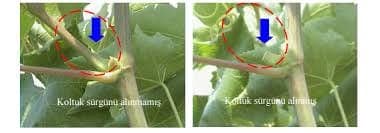
- Performing summer pruning is also important for obtaining a good wine. What is summer pruning? It is the pruning of excess leaves from the vines in a way that the clusters are not exposed to too much sun. Additionally, the importance of “lateral shoot” (sucker) pruning in summer pruning is quite high. A grape cluster is fed by the leaf directly opposite it. However, if there is another leaf between the two—which we call a lateral shoot—this leaf also feeds off the leaf that the cluster is fed by, sharing the nutrients the cluster receives. This prevents the cluster from becoming concentrated and therefore lowers the quality of the wine. In the adjacent visual, we see the lateral shoot and its pruned state.
- Wine grape cultivation is significantly different from table grape cultivation. Here, the goal is not large berries but grapes with high aromatic concentration. For this purpose, producers increase the amount of nutrients per grape by limiting the vineyard yield (cluster pruning). Thus, the balance of sugar, acid, and phenolic components in the fruit becomes ideal. Especially red wine grapes like Cabernet Sauvignon, Merlot, and Syrah are sensitive to this balance.
- Although watering the vineyard without exaggeration according to climate conditions is an important point, we know that some wineries may not irrigate their vineyards. So what does this lead to? The unirrigated vine enters stress and goes deep to find water. This means it will receive much more nutrients and minerals from the depths. That is, the vine goes deep to find water, but it also adds other factors that enrich the concentration and aroma of the grape to its structure, i.e., the grape. This directly affects the quality of the wine. Additionally, excessive irrigation causes the grape berries to swell by filling with water. This leads to a disruption of the sugar-acid balance.
Also;
- Planting windbreak plants around the vineyard for microclimate management.
- Taking precautions against hail events.
- Increasing soil moisture through the use of organic mulch.
- Creating a fertilization plan based on soil analysis.
- Applying shading systems to reduce vine stress.
- Spraying for fungi, pests, and weeds are also among important viticulture activities.
Executing Winery Management Correctly
- Grapes must be harvested from the vineyards at the right time. Grapes that have not reached the desired sugar level are not harvested. In such a situation, we can neither achieve the desired alcohol level (between 11.5% and 15%) nor will the resulting wine be anything but highly acidic. That is, the wine will be unbalanced, sour, and not pleasant to drink. Essentially, we cannot even call such a resulting product wine. With the help of tools that measure the sugar of the grape in the vineyard (refractometer), we can determine the harvest time.
- Harvest is done in the cool. This is important to prevent bacteria growth on the clusters. Generally, early morning hours are suitable for this.
- Whether the harvest is done by hand or by machine is not a factor that determines quality.
- Grapes do not like long journeys. In long transport conditions to the winery after harvest, uncontrolled fermentation may start and microorganisms we do not like at all may become active. Such a situation negatively affects the quality of the wine. It is for this reason that some wineries produce “chateau” style. That is, the winery is right next to the vineyards. Thus, the harvested grapes go into processing immediately without being subjected to long transport conditions. However, if the transport of grapes is inevitable, they should be transported with a cold chain system.
- Care should be taken not to crush the grapes during their transport to the winery. This situation leads to the uncontrolled start of fermentation.
- Grapes arriving at the winery enter processing immediately. Red and white winemaking processes are very different from each other. This subject is a topic to be handled in detail later under the heading how wine is made. However, roughly the production vinification process is as follows:
- Grape processing (crushing, de-stemming, pressing)
- Fermentation control
- Temperature
- Yeast selection
- Sugar–alcohol conversion
- Maceration periods
- Malolactic fermentation management
- Clarification, stabilization, and filtration
The proper progression of winemaking processes and full compliance with hygiene conditions are important matters.
- The maturation process after fermentation needs to be managed well. This process takes place in oak barrels or inert tanks. Towards the end of the process, a decision is made on when the wine will be bottled based on analyses.
- During the maturation process, the ambient temperature should ideally be around 14-15 degrees Celsius. It should be specifically noted that maturation almost stops below 10 degrees. The wine cannot develop, remains “closed,” and cannot show its potential in the long run. Above 18 degrees, the wine ages prematurely, aromas fade quickly, oxidation increases, and cooked/flat tastes may form.
- Additionally, the humidity of the storage area should be around 75%. This is important for wines set aside for aging. Humidity ensures the cork swells, preventing the wine in the bottle from taking in air. Below this ratio, the cork may dry and shrink, causing the wine to take in air and spoil. Conversely, above this ratio causes the cork to mold. Cellars are accepted as the ideal storage area for wine as they provide these desired conditions.
- Quality control must be performed before bottling. Errors should be identified through chemical analyses (alcohol, pH, acidity, SO₂, etc.) and sensory analyses. The correct cork/cap selection should be made. The cork for wines to be set aside for aging should be selected accordingly.
- Traceability by batch must be ensured for bottled wines.
Remember, good wine cannot be made from bad grapes. However, bad wine can be made from good grapes. A beautiful and quality wine emerges through the processing of good grapes under the right conditions.
Related Posts
Snackable Information in the Taste of Wine Part - 1
You can find bite-sized information about wine in this article.
On Wine-Food Pairing
We discuss the importance of pairing wine with food and explore the most ideal combinations.
Journey Through the History of Wine
Learn about the history of wine and discover the wine journey.